
The national poverty rate is 14.7 percent.
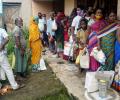
As the poverty rates in the country declined below 5 percent in 2024, a research study by State Bank of India also highlighted that the extreme poverty in the country has been reduced to minimal.

The question for the next 20 years is not whether India can become a $5 trillion or $10 trillion economy. Those are attractive targets, but the real question is whether India can create enough productive jobs, educate its children properly, make its cities liveable, and give hundreds of millions of people a substantially better life, asserts Ramesh Menon.

Underlining that students are the "architects of India's future," President Droupadi Murmu on Friday said the government is taking comprehensive steps to reform public examinations to completely curb paper leaks and unfair means, making the system transparent, secure, and trustworthy.

In her address to the nation on the eve of the country's 80th Independence Day, the president stressed that just as government and society remain united to ensure national security, everyone must contribute through joint and concerted efforts to safeguard the present and future of students.
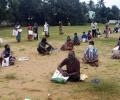
India's extreme poverty rate declined sharply to 5.3 per cent over a decade from 27.1 per cent in 2011-12 even as the World Bank revised upwards its threshold poverty line to $3 per day.
The study 'Orissa in Transition: From Fiscal Turnaround to Rapid and Inclusive Growth' was conducted by the World Bank in 2007. The study found that the poverty headcount ratio for the state, after rising during 1993-99, declined during 2000-2005 by more than 8 percentage points in rural Orissa and 2.5 percentage points in urban Orissa. This is better than the all-India average decline of 5 percentage points for urban India and 2 percentage points for rural India.

'All governments are scared of a negative image.' 'Somehow, this government has a tendency to create a narrative that things are improving.' 'When the real data gives a different picture, they are upset.'

'Workers are the people who create all the wealth in this country. How can you call them anti-national?'

The key question is how much of the latest growth record represents recovery from the 2020-2021 downturn, and what is the sustainable growth rate now, asks T N Ninan.

Hosabale blamed the "faulty' economic policies of the earlier governments for the "ills" in the economy.

'Without a poverty line, how are we to know whether poverty is the same, or it has come down or it has gone up?'
Claims of a spike in poverty and inequality in India during the Covid-19 pandemic are patently false as such claims are based on uncomparable different surveys, according to a paper co-authored by eminent economist Arvind Panagariya. The paper also noted that inequality fell in the country during Covid years, both in rural and urban areas as well as nationally. Panagariya, Columbia University Professor and former vice chairman of NITI Aayog and Vishal More of Intelink Advisors, New Delhi have co-authored a detailed paper 'Poverty and Inequality in India: Before and After Covid-19'.
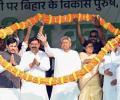
If he cannot do it this term by using his bureaucracy and experts from different fields, it will be a tragedy, asserts Ramesh Menon.
Concerned over the plight of 220 million people living below poverty line, President A P J Abdul Kalam on Friday suggested increasing of overall GDP growth rate to 10 per cent and maintaining it for a decade.

'...the electoral playing field is tilted significantly in its favour.'
.jpg)
The CPI(M) on Thursday slammed the Planning Commission estimates on poverty levels in the country, saying these made "a mockery of life and death struggles" of the people, amidst continuous rise in prices and "massive" slashing of subsidies for the poor.
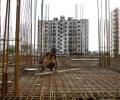
The construction sector is now India's second-largest employer after agriculture, the trend coinciding with India's high-growth phase and decline in poverty levels

President Droupadi Murmu's address to the nation on the eve of the 79th Independence Day.

Karnataka minister Satish Jarkiholi on Wednesday said the guarantee schemes need to be reviewed so that only the economically weaker sections, and not the rich, benefit from them, sparking a debate on the ambitious programmes launched by the Congress government.

While data can empower communities, it reinforces identities, making local politics more caste-centric, with decisions increasingly contested on the grounds of representation.
Such dynamics could lead to shifting alliances and, in the worst case, local governance getting paralysed as each group demands proportional power-sharing, explain Amitabh Kundu and Mehebub Rahaman.
India's economic growth forecast for 2025 has been revised downward to 6.3 per cent, and despite a projected moderation, the country remains one of the fastest-growing large economies, supported by resilient consumption and government spending, the United Nations has said.
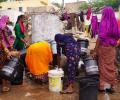
In Rajasthan's Karauli district, a decade ago, rampant drought and dwindling water sources forced many men into a life of dacoity, leaving their families in fear. However, the women of Karauli, tired of the despair, took matters into their own hands. They persuaded their husbands to give up their lives of crime and together they began reviving old water bodies and constructing new ones with the help of a local NGO. This community-led effort, which included building pokhars (water bodies) and reviving the Serni River, resulted in a remarkable transformation, bringing stability and hope to the region, and turning former dacoits into thriving farmers.

'Due to this sudden phenomenon, guests stopped visiting the homes of these villages, girls and boys from these villages were not getting proposals; students were reluctant to attend schools and colleges for fear of being shamed.'

The Planning Commission's latest poverty estimates, based on the 2011-12 consumption expenditure survey, shows that across India, the number of people living below the poverty line declined by more than 15 percentage points -- from 2004-05 to 2011-12 and from 37 per cent to 21.9 per cent.
The report said the global economy will lose $12 trillion or more by the end of 2021 despite spending of $18 trillion in trying to stimulate growth around the world.
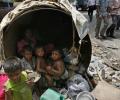
Angus Deaton's Nobel Prize should spark off more research on the measurement and usefulness of poverty percentages.
Majority of 'Bimaru' states register faster fall in rural poverty, while pace mostly other way round for others
Figures of people living below the poverty line in India was being fudged by international agencies like the World Bank to paint a grim picture of the Indian economy, Planning Commission Member N K Singh said on Monday.
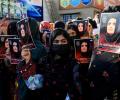
'When so many young Baloch men and women are willingly volunteering as fighters and even suicide bombers.'

But as a record number of Indians enter the American stream, a new problem emerges. Poverty

The situation raises concerns about whether the promised freebies will once again push the state into a revenue deficit.
The 'India Corruption Study 2007', brought out by NGOs Transparency International India (TII) and Centre for Media Studies (CMS), found that about one-third of Below Poverty Line (BPL) households in the country bribed officials to avail a total of 11 services -- from police to PDS.
The 'poor' also own TVs and two-wheelers and no discussion of poverty is complete unless it acknowledges this.
While India boasts of its nuclear strength, 600 million people are still living in darkness, 150 million do not have access to health clinics and farmers' suicides make it to the pages of newspapers now and then, Tharoor said at a 'Face To Face' programme organised by Bengal Initiative, a conclave of front-runners in different fields of the state, on Sunday night.

A programme that endeavours to graduate the poorest people could have seminal implications for Prime Minister Narendra Modi's government.
Sudama Mahto has been accused of distributing the cards to favour an electoral candidate.
A survey conducted by the National Sample Survey Organisation has revealed that 51 per cent or more than half of India's rural households (marginal farmers possessing less than 1,076 square feet of land) have no ration card at all.
